

Events
Science Faculty Distinguished Lecture – Prof. Klaus MÜLLEN
3 Nov 2026
3:00 pm – 4:30 pm
Lecture Theatre 8, Yasumoto International Academic Park (YIA), CUHK
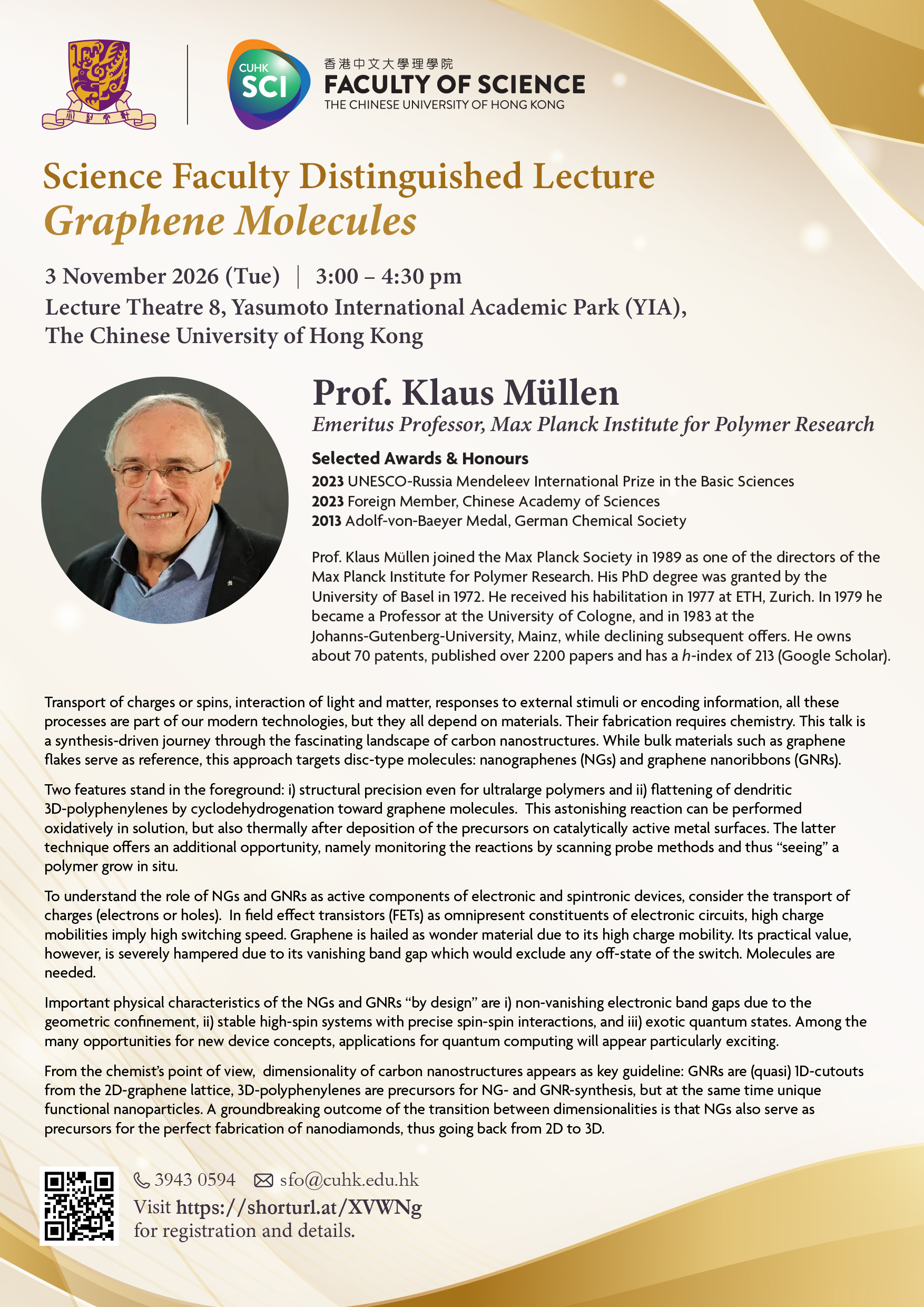
Prof. Klaus MÜLLEN
Selected Awards & Honours
2023 UNESCO-Russia Mendeleev International Prize in the Basic Sciences
2023 Foreign Member, Chinese Academy of Sciences
2013 Adolf-von-Baeyer Medal, German Chemical Society
Prof. Klaus Müllen joined the Max Planck Society in 1989 as one of the directors of the Max Planck Institute for Polymer Research. His PhD degree was granted by the University of Basel in 1972. He received his habilitation in 1977 at ETH, Zurich. In 1979 he became a Professor at the University of Cologne, and in 1983 at the Johanns-Gutenberg-University, Mainz, while declining subsequent offers. He owns about 70 patents, published over 2200 papers and has a h-index of 213 (Google Scholar).
sfo@cuhk.edu.hk | 3943 0594
CUHK Science is pleased to welcome Prof. Dr. Klaus MÜLLEN, Emeritus Professor of the Max Planck Institute for Polymer Research, for a Science Faculty Distinguished Lecture.
Transport of charges or spins, interaction of light and matter, responses to external stimuli or encoding information, all these processes are part of our modern technologies, but they all depend on materials. Their fabrication requires chemistry. This talk is a synthesis-driven journey through the fascinating landscape of carbon nanostructures. While bulk materials such as graphene flakes serve as reference, this approach targets disc-type molecules: nanographenes (NGs) and graphene nanoribbons (GNRs).
Two features stand in the foreground: i) structural precision even for ultralarge polymers and ii) flattening of dendritic 3D-polyphenylenes by cyclodehydrogenation toward graphene molecules. This astonishing reaction can be performed oxidatively in solution, but also thermally after deposition of the precursors on catalytically active metal surfaces. The latter technique offers an additional opportunity, namely monitoring the reactions by scanning probe methods and thus “seeing” a polymer grow in situ.
To understand the role of NGs and GNRs as active components of electronic and spintronic devices, consider the transport of charges (electrons or holes). In field effect transistors (FETs) as omnipresent constituents of electronic circuits, high charge mobilities imply high switching speed. Graphene is hailed as wonder material due to its high charge mobility. Its practical value, however, is severely hampered due to its vanishing band gap which would exclude any off-state of the switch. Molecules are needed.
Important physical characteristics of the NGs and GNRs “by design” are i) non-vanishing electronic band gaps due to the geometric confinement, ii) stable high-spin systems with precise spin-spin interactions, and iii) exotic quantum states. Among the many opportunities for new device concepts, applications for quantum computing will appear particularly exciting.
From the chemist’s point of view, dimensionality of carbon nanostructures appears as key guideline: GNRs are (quasi) 1D-cutouts from the 2D-graphene lattice, 3D-polyphenylenes are precursors for NG- and GNR-synthesis, but at the same time unique functional nanoparticles. A groundbreaking outcome of the transition between dimensionalities is that NGs also serve as precursors for the perfect fabrication of nanodiamonds, thus going back from 2D to 3D.